




 Pay a Ticket
 Get a Permit
 Pay a Water Bill




How is Doylestown affected by PFAS?
Beyond the obvious health concerns, the impact of PFAS on a small water system like Doylestown Boroughs is enormous. The costs of installing PFAS treatment systems run into the millions of dollars, and these systems must then be maintained and monitored. This places a heavy burden on an annual budget of less than $1.5 million.

The Borough of Doylestown is not in a unique position when it comes to dealing with PFAS issues. Many other local water systems also have PFAS present in their source water. This includes Doylestown Township, who has an interconnection with the Borough. This interconnection allows both systems to give and take water when needed and helps supplement system capacity during emergency situations.
Beginning in 2023, the Borough proactively commissioned its water engineering consultant, Arrow Engineering (formerly CKS Engineering), to conduct a comprehensive evaluation of treatment options to address the presence of per- and polyfluoroalkyl substances (PFAS) in the Borough’s groundwater supply wells. This study assessed regulatory requirements, available treatment technologies, long-term operational considerations, and overall cost effectiveness to identify a sustainable solution for protecting public health and maintaining compliance with current and anticipated drinking water standards.
Upon completion of the evaluation, the study concluded that the installation of granular activated carbon (GAC) treatment systems represented the most effective and financially responsible approach for PFAS remediation. Based on water quality data, system hydraulics, and infrastructure considerations, it was recommended that treatment systems be installed at three of
the Borough’s five groundwater well locations.
In 2024, the Borough applied for financial assistance through the Pennsylvania Infrastructure Investment Authority (PENNVEST) to support the implementation of these improvements. The application was successful, resulting in the award of approximately $5 million in grant funding, along with an additional $1 million in low-interest loan financing. These funds are designated for
the design and construction of PFAS treatment systems at Wells 9, 10, and 12.
Public bidding for the construction phase was completed in mid-2025, and contracts were awarded in accordance with state and local procurement requirements. Construction of the treatment facilities is scheduled to begin in early 2026.
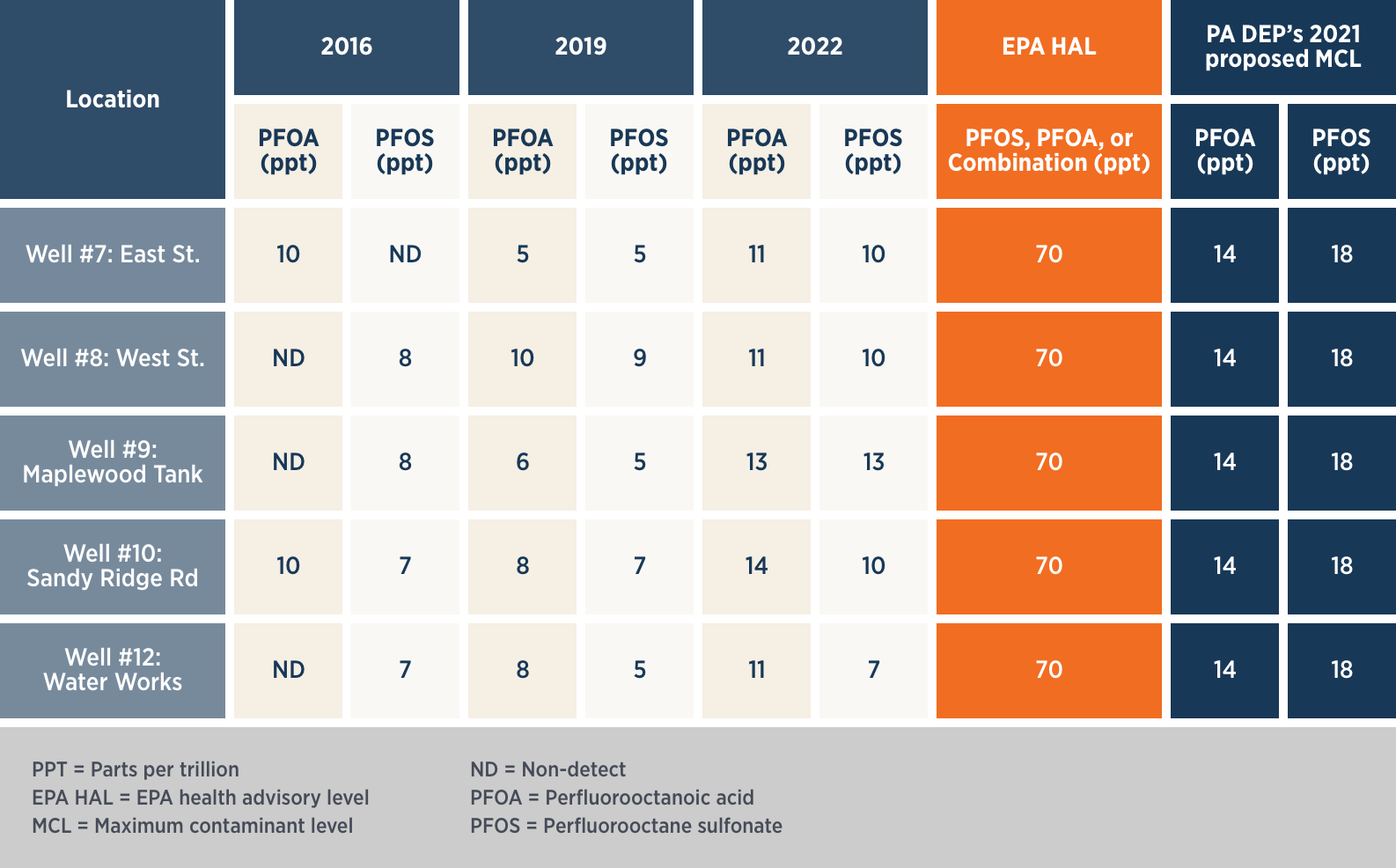
There is no significant difference in treatment systems and infrastructure to treat PFAS to the EPA’s health advisory level of <0.004, compared to PA DEP’s proposed MCL of 14 & 18 ppt. Therefore, any treatment system that is installed will have the goal of meeting the EPA’s health advisory and treat to zero.
It appears that a significant amount of federal and state funding may be available to help get the treatment upgrades needed. Under the Bipartisan Infrastructure Law up to $5 billion will become available between 2022-2026. These funds are being made available to help combat “emerging contaminants”, including PFOA and PFOS. Eligible applicants for this grant funding need to meet a certain criterion as either a “Disadvantaged Community” or “Small Community”. Doylestown Borough meets the small community criteria, with a population of less than 10,000, according to the latest census data.